
SpaceX Starship Booster 21 Static Fire: Flight 14 Nears
Spacex Starship Flight news: SpaceX Starship Booster 21 has successfully completed a full-duration static fire test, firing all 33 Raptor engines for approximately 15 seconds at Starbase, Texas, on August 28, 2026. The major test brings SpaceX closer to Starship Flight 14, which is expected to attempt the vehicle’s first orbital mission in early September.
The successful test is being viewed as a major qualification milestone for SpaceX’s next-generation Starship program. Booster 21 had already completed a six-engine static fire on August 21 and individual engine tests on August 20, allowing engineers to progressively validate the booster’s propulsion systems.
SpaceX Starship Booster 21 Completes Full Static Fire – Spacex Starship Flight 14 The August 28 test marked the most significant propulsion test for Booster 21 ahead of Flight 14. During the test, all 33 Raptor engines were fired simultaneously for around 15 seconds.
Static fire tests allow SpaceX engineers to evaluate rocket engines and associated systems while the vehicle remains secured to the launch infrastructure. The results can provide critical information about engine performance, fuel systems, ground equipment and overall launch readiness. For Booster 21, the full-duration test represents an important step toward orbital operations.
Spacex Starship Flight 14 The booster had previously undergone smaller-scale engine tests, including single-engine firings on August 20 and a six-engine test on August 21. The progression suggests SpaceX has been systematically checking the propulsion system before attempting the much more demanding Flight 14 mission.
Spacex Starship Flight 14, Starship Flight 14 Could Attempt First Orbital Mission-Flight 14 is expected to represent a major change in SpaceX’s Starship test program.
The previous 13 Starship flights were suborbital test missions. Flight 14 is planned to take the program toward orbital operations, potentially making it the first Starship mission designed to place the spacecraft and payload into Earth orbit. According to SpaceNews reporting, the mission is expected to deploy approximately 20 Starlink V3 satellites.
An orbital mission would be an important milestone for SpaceX because Starship is being developed as a fully reusable launch system capable of carrying significantly larger payloads than existing rockets.
Spacex Starship Flight 14 – Starlink V3 Satellites Add Commercial Importance, The planned Starlink V3 deployment gives Flight 14 an additional commercial dimension.
Starlink V3 satellites are designed to provide substantially greater broadband capacity than earlier Starlink generations. Reports have indicated that V3 satellites could offer around ten times the capacity of previous generations.
Starship’s large payload capacity could allow SpaceX to launch approximately 20 V3 satellites on a single mission. That capability could eventually reduce the number of launches required to expand the Starlink constellation while increasing the amount of satellite capacity placed into orbit.

The economics of satellite deployment are particularly important for SpaceX because Starlink has become one of the company’s major commercial businesses.
Flight 13 Provided an Important Demonstration- Spacex Starship Flight 14 The upcoming orbital attempt builds on the progress achieved during Starship Flight 13 on July 24, 2026.
Flight 13 reportedly deployed 20 Starlink V3 satellites during its suborbital trajectory and achieved what was described by industry tracking reports as SpaceX’s softest booster splashdown to date.
Flight 14 is expected to take another step forward by targeting orbital insertion, Starlink deployment and a complete deorbit sequence. The combination of these objectives could provide SpaceX with valuable data about Starship’s ability to operate beyond a suborbital trajectory.
Spacex Starship Flight 14 – Why Starship Flight 14 Matters for SpaceX, The significance of Flight 14 goes beyond a single rocket launch.
SpaceX is developing Starship as a reusable transportation system intended to support satellite deployment, human spaceflight, lunar missions and potentially future Mars missions. A successful orbital mission would therefore represent an important validation point for the company’s long-term strategy.
UBS analysts have also highlighted the importance of Flight 14, pointing to orbital capability, Starlink V3 deployment and booster catch/reusability as important demonstrations for SpaceX’s future growth. If Starship can eventually achieve reliable and rapid reusability, the economics of launching large payloads could change significantly.
Spacex Starship Flight 14, Starship Could Transform Satellite Launch Economics-One of Starship’s biggest potential advantages is its enormous payload capacity. Falcon 9 has already become a highly successful reusable launch vehicle, but Starship is designed to operate on a much larger scale. Its massive payload bay could allow SpaceX to deploy many more satellites per mission.
For Starlink, this could mean faster constellation expansion and potentially lower launch costs per satellite. For the broader commercial space industry, successful Starship operations could increase competition and create new opportunities for large satellite constellations, scientific missions and other space-based infrastructure.
Spacex Starship Flight 14 What Happens Next? Following the successful Booster 21 static fire, attention now turns toward final preparations for Flight 14. SpaceX will still need to complete additional technical reviews, launch-site preparations and regulatory requirements before the vehicle can fly.

Spacex Starship Flight 14, If everything remains on schedule, Flight 14 could become one of the most important Starship missions yet, as the company attempts to move from repeated suborbital testing toward sustained orbital operations. The planned Starlink V3 deployment also means the mission could provide a direct demonstration of Starship’s potential commercial role.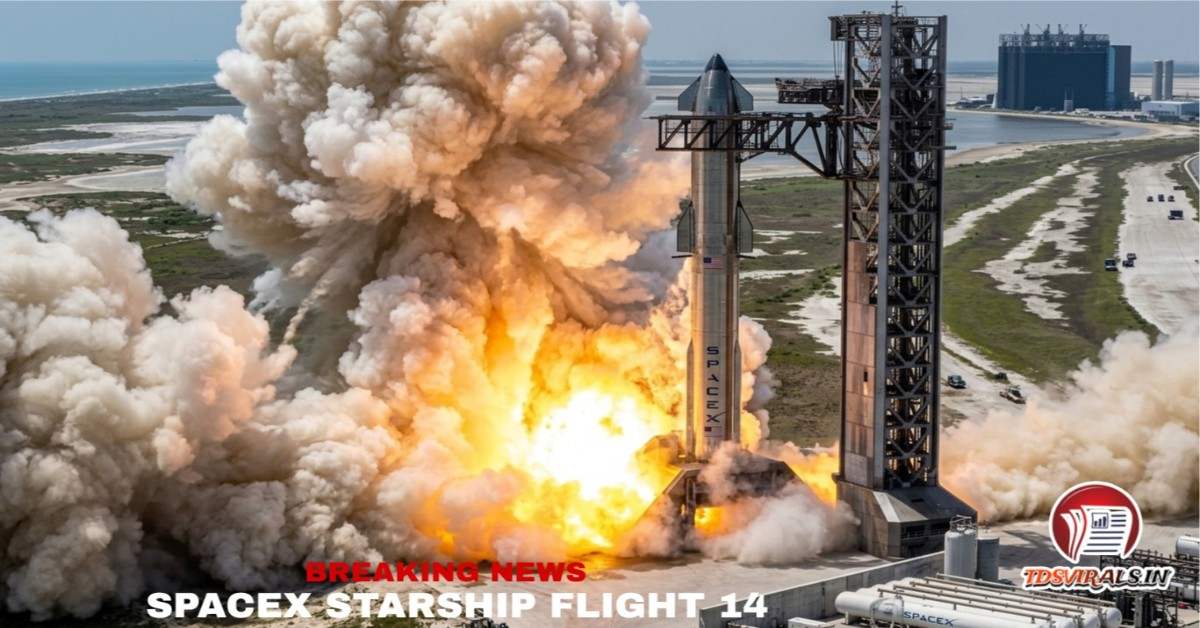
Spacex Starship Flight 14 – For SpaceX, investors and the wider commercial space industry, the outcome could offer an important indication of how quickly Starship can progress toward routine orbital launches.
Frequently Asked Questions – Spacex Starship Flight 14
When did SpaceX conduct Booster 21’s full static fire?
SpaceX conducted the full-duration static fire test of Starship Booster 21 on August 28, 2026.
How many engines were fired during the Booster 21 test?
All 33 Raptor engines were fired simultaneously during the test.
How long did the Booster 21 static fire last?
The full-duration static fire lasted approximately 15 seconds.
When is Starship Flight 14 expected?
Starship Flight 14 is currently targeted for early September 2026, subject to final preparations, regulatory approvals and weather conditions.
What will Starship Flight 14 attempt?
Flight 14 is expected to attempt Starship’s first orbital mission, including orbital operations and Starlink V3 satellite deployment.
How many Starlink V3 satellites could be deployed?
The mission is expected to carry approximately 20 Starlink V3 satellites.
Why are Starlink V3 satellites important?
Starlink V3 satellites are designed to provide substantially greater broadband capacity than earlier Starlink generations, potentially increasing the capacity of SpaceX’s satellite internet network.
Why is Booster 21 important?
Booster 21 is important because its successful full-engine static fire provides another major propulsion-system validation step before SpaceX attempts the next stage of Starship testing.











 Home
Home
 Facebook
 Twitter
 Instagram
 Call
Call
 WhatsApp