
Spacex Nasa Roman Space Telescope Launch on SpaceX Falcon Heavy to Explore Dark Universe
United States news: NASA’s Nancy Grace Roman Space Telescope has successfully launched aboard a SpaceX Falcon Heavy rocket, beginning a three-month journey toward its final orbit around the second Sun-Earth Lagrange point, known as L2. The powerful launch took place at 7:26 a.m. EDT on Sunday, August 30, 2026, from Launch Complex 39A at NASA’s Kennedy Space Center in Florida.
The mission marks a major milestone for NASA’s next-generation space science program. Roman is designed to provide astronomers with an unprecedented combination of a wide field of view and high-resolution infrared vision, allowing scientists to investigate some of the biggest mysteries in the universe.
Spacex Nasa Roman Space Telescope Launch Nancy Grace Roman Space Telescope Begins Million-Mile Journey-Following liftoff, NASA’s ground control team at the Goddard Space Flight Center in Greenbelt, Maryland, began receiving telemetry from the spacecraft approximately seven minutes after launch.
The Falcon Heavy rocket performed as planned, with the spacecraft separating from the launch vehicle around 31 minutes into the flight. The rocket’s reusable boosters subsequently returned safely to the launch area for refurbishment. Roman is now heading toward L2, located approximately one million miles from Earth. This location will provide the telescope with a stable environment for observing deep space and conducting large-scale astronomical surveys.
NASA said the Deep Space Network took over communications about 70 minutes after launch. Communications will be maintained through NASA facilities in Canberra, Madrid, and Goldstone during the spacecraft’s journey.
Roman Telescope Will Study Dark Matter and Dark Energy, Spacex Nasa Roman Space Telescope Launch-One of the primary objectives of the Nancy Grace Roman Space Telescope is to improve scientists’ understanding of dark matter and dark energy, two of the biggest unanswered questions in modern cosmology.
Dark matter cannot be directly observed through ordinary light, but its gravitational influence can be detected. Dark energy, meanwhile, is associated with the accelerated expansion of the universe. Roman’s enormous survey capabilities will allow scientists to collect massive amounts of astronomical data and study how galaxies and cosmic structures have evolved over billions of years.
Spacex Nasa Roman Space Telescope Launch -The telescope will also search for and study exoplanets, or planets located outside our solar system. These observations could help researchers better understand how planetary systems form and evolve.
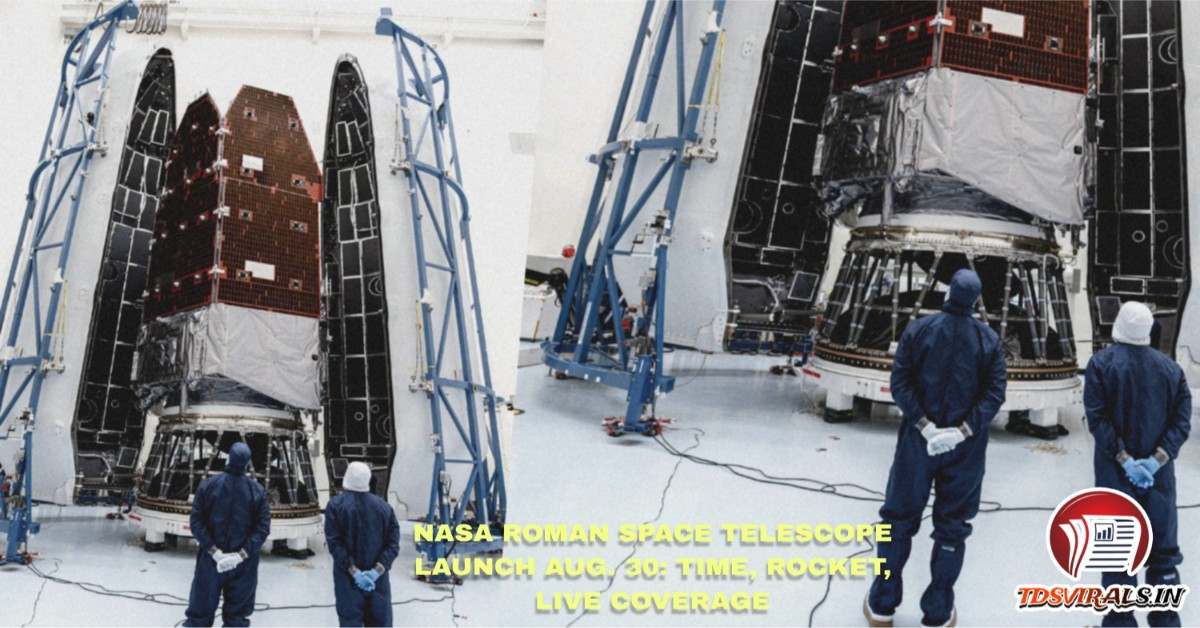
Spacex Nasa Roman Space Telescope Launch NASA Confirms Successful Solar Panel Deployment-NASA confirmed that Roman successfully deployed its solar panels and lower instrument sun shade approximately one hour and 23 minutes after launch.
Several other critical deployments and activation procedures are scheduled during the early phase of the mission. These include deployment of the high-gain antenna and the telescope’s protective aperture cover. Ground controllers will also conduct the first of two planned mid-course corrections as Roman continues toward L2.

Spacex Nasa Roman Space Telescope Launch Coronagraph Instrument Could Help Search for Other Worlds-A major technology demonstration aboard Roman is the Coronagraph Instrument. The instrument is designed to block out the intense light from stars, making it easier for scientists to observe much fainter objects orbiting them.
During its technology demonstration, Roman’s coronagraph is expected to image Jupiter-like planets. The technology could eventually contribute to future missions designed to directly image Earth-like planets and investigate whether they could potentially support life. NASA has described this work as an important step toward future concepts such as the Habitable Worlds Observatory.
Spacex Nasa Roman Space Telescope Launch update,300-Megapixel Infrared Camera-Roman’s primary scientific instrument is the Wide Field Instrument, an advanced 300-megapixel infrared camera.
The camera contains 18 4K detectors designed to capture huge amounts of infrared information from the cosmos. Unlike traditional telescopes that may spend considerable time observing relatively small sections of the sky, Roman is designed to survey enormous areas rapidly. NASA says Roman will be capable of surveying the universe about 1,000 times faster than the Hubble Space Telescope, making it a powerful tool for large-scale astronomical research.
Spacex Nasa Roman Space Telescope Launch news, Roman Will Generate 1.4 Terabytes of Data Every Day-The telescope is expected to transmit approximately 1.4 terabytes of scientific data every day, making it the highest data rate achieved by a NASA astrophysics mission so far.
Processing this enormous volume of information will require advanced computing techniques. Machine learning, artificial intelligence, and citizen scientists are expected to help researchers identify important patterns and potential discoveries. Scientists will then investigate the most promising observations in greater detail.
Spacex Nasa Roman Space Telescope Launch When Will Roman’s First Images Be Released? NASA expects the telescope to spend approximately three months undergoing commissioning. During this period, engineers and scientists will calibrate and test its instruments and systems.
The agency currently anticipates releasing the first Roman Space Telescope images by early 2027. These first images will provide an early demonstration of Roman’s capabilities and could offer scientists their first detailed look at the universe through its unique combination of wide-field and infrared observations.
Spacex Nasa Roman Space Telescope Launch A New Era for Space Astronomy-NASA Administrator Jared Isaacman described Roman as an important example of successful cooperation between NASA and its industry partners.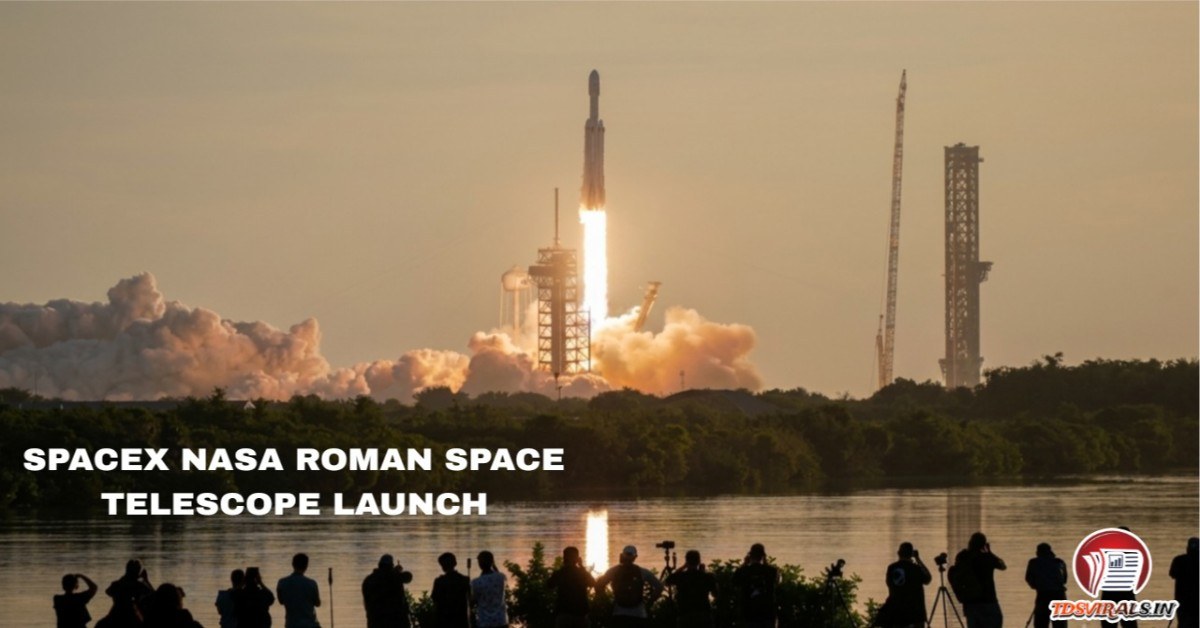 The telescope is managed by NASA’s Goddard Space Flight Center, with contributions from the Jet Propulsion Laboratory, Caltech/IPAC, the Space Telescope Science Institute, and scientists from research institutions around the world. Major industrial partners include BAE Systems, L3Harris Technologies, and Teledyne Scientific & Imaging. International contributions come from organizations including ESA, JAXA, France’s CNES, and Germany’s Max Planck Institute for Astronomy.

Roman is the fourth primary NASA mission launched aboard a Falcon Heavy rocket. With its ability to rapidly map enormous sections of the sky, study dark energy and dark matter, and investigate distant planetary systems, the Nancy Grace Roman Space Telescope could fundamentally expand humanity’s understanding of the universe.
FAQs-Spacex Nasa Roman Space Telescope Launch About Nancy Grace Roman Space Telescope
1. What is the Nancy Grace Roman Space Telescope?
The Nancy Grace Roman Space Telescope is a NASA space observatory designed to study dark energy, dark matter, exoplanets, galaxies, and the evolution of the universe.
2. When did NASA launch the Roman Space Telescope?
NASA launched Roman on August 30, 2026, aboard a SpaceX Falcon Heavy rocket from Kennedy Space Center in Florida.
3. Where is the Roman Telescope going?
Roman is traveling toward the second Sun-Earth Lagrange point, or L2, approximately one million miles from Earth.
4. What will the Roman Telescope study?
Its major science goals include studying dark matter, dark energy, exoplanets, galaxy formation, and cosmic evolution.
5. When will Roman’s first images be released?
NASA anticipates releasing the telescope’s first images by early 2027 following its commissioning and calibration period.
6. How much data will Roman send to Earth?
NASA expects Roman to transmit approximately 1.4 terabytes of data per day.
7. Is Roman faster than Hubble?
Roman is designed to survey the universe approximately 1,000 times faster than NASA’s Hubble Space Telescope because of its wide field of view and rapid survey capabilities.








 Home
Home
 Facebook
 Twitter
 Instagram
 Call
Call
 WhatsApp